Rooted in Resilience: Youth Step Into a Living Forest Classroom
December 30, 2025
The rain did us a quiet favour.
The day before our training, it poured, hard enough that we wondered if the forest would be slog and struggle. Instead, the land greeted us rinsed and ready, cedar-scent fresh, every trunk and lichen luminous. By morning, clouds thinned, air softened, and it felt as if yesterday’s downpour had pressed the “refresh” button on the woods, perfect for a day of learning, sharing, and walking with care.
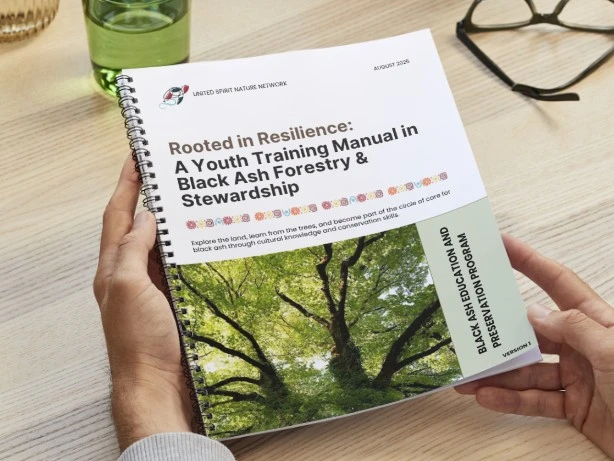
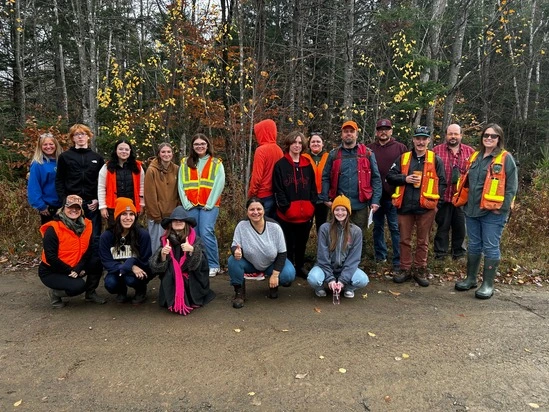
By 9:30 a.m., our circle formed: four instructors from the Maritime College of Forest Technology (MCFT), one USNN representative, two from NBICC, ten keen youth from Oromocto High School, and, most importantly, Rodney Bear, a respected Knowledge Keeper from Woodstock First Nation and a gifted black ash basket maker. We opened with gratitude and purpose. Gareth Davies (MCFT Director & Forestry Instructor) and Sama AlMaarofi (USNN Executive Director) framed the “why”: this training wasn’t just skills, it was relationship, responsibility, and resilience, with black ash at the heart. Students ate, packed snacks for the trail, and we set off to split our day between an orientation at MCFT and a field practice in nearby forested land, guided by the new Rooted in Resilience: A Youth Training Manual in Black Ash Forestry and Stewardship.


Into the forest: learning with our senses
Before our boots reached the first plot, Rodney was already teaching, from the ground up. He pointed out widely growing medicine plants and gently threaded stories of use and respect through each stop. The MCFT team layered safety and geography, where we were, how we’d move, why forest matter, then set the group to work with the simplest tools we carry everywhere: hands, eyes, ears.
Black ash ID came alive through touch and contrast. Students ran their fingers over the bark’s flaky plates, then compared it to the firmer ridges of white ash. On the forest floor, they sifted through fallen leaflets to see how each species arranges itself, patterns as signatures. Over three hours and three sites, youth learned to “read” a place: the damp hollows and gentle slopes where water lingers, nutrients settle, and black ash thrives. “So… black ash likes it wet?” someone asked. Smiles and nods. A first field clue, unlocked.
Curiosity quickly spilled beyond ash. Lichens caught their eyes, especially a radiant, leaflike one they’d never seen before: lungwort (Lobaria pulmonaria), a living mosaic of fungus + cyanobacteria + algae working as one. Students were amazed to realize they were looking at a three-part symbiosis, a green “lung” for clean air taped to the side of a strong ash. Fungi joined the roll call: turkey tail, false tinder conk, the violet-toothed polypore (with its stories of respiratory uses shared in the field), and a grin-inducing tangent about the famous “humongous fungus.” Learning-by-seeing soon became learning-by-asking, and questions came fast enough to keep four instructors joyfully busy with just eight students at a time.
We paused at a butternut as one instructor reflected aloud: this tree is listed as threatened, while black ash often still isn’t given the same protection in many places, yet its cultural and ecological importance is profound. His point landed: legal status lags; stewardship can’t. (A theme echoed in USNN’s Black Ash project work.)


Rodney’s basket teachings
Rodney’s teachings braided culture and craft:
- The straightness of the stem matters, straight grain makes smoother pounding and cleaner splints.
- In a healthy environment, black ash stretches tall before it branches, ideal for harvesting.
- Wider growth rings? Better for basket making.
- Bark defects? They weaken the quality of splints.
- And a cultural note: Wabanaki people pound black ash differently than Mi’kmaq, a reminder that “Indigenous knowledge” is rich, specific, and diverse, not a monolith.
Students also measured trees, pausing, jaws dropped, at a basswood whose trunk wrapped the tape at 80.8 cm. They spotted a woodpecker’s tidy work, spiral rows of sap wells marching round the bark. And they listened as Rodney shared a favourite practical teaching: how spruce gum, cleaned and boiled, has long been used as an adhesive for patching canoe cracks, and how fresh gum can be rubbed on small wounds like a natural bandage.


A day that moved too quickly
Three hours disappeared in a blink. The forest opened doors, and the youth kept walking through them, question after question, connection after connection. On our way out, someone said what many were feeling: “I didn’t want to leave.” We left offerings instead, gratitude, care, and the pledge to return.
Back at the end of the day, USNN gifted copies of Rooted in Resilience: A Youth Training Manual in Black Ash Forestry and Stewardship to the OHS teacher and to MCFT to keep the learning moving forward. The training itself was designed as a half-day experience for the Oromocto High School Indigenous Leadership Program, mixing core forestry skills, habitat assessment, data collection methods, and journaling/field activities, with cultural knowledge woven throughout by Indigenous leaders.

From the organizer’s notebook
I’ll be honest, I was nervous. Picture a group of teens, off their phones, out of their routines, asked to notice bark textures and read landscapes. Would this land-based classroom hold their attention?
Nature took care of that in the first five minutes.
The questions came in waves; the interest was real and deep. I’ve never seen this many hands go up in a conventional classroom after a lecture. The forest is a teacher who speaks in clues, lichen on ash, moisture at a toe slope, a ring wider than a thumbnail, and every clue invites a new question. By the end, instructors were joyfully stretched meeting students’ curiosity at once. That is a good problem to have.
We also collected student testimonials. What I can share now is simple: I saw interest. I saw connection. I saw need, and an unmet hunger, for this kind of learning. The day before, rain; the day of, a torrent of questions. Balance restored.


Why this training matters (and where it comes from)
This session is part of USNN’s Preserving Black Ash initiative: community-powered conservation that pairs Traditional Ecological Knowledge with science to protect a culturally vital wetland tree threatened by pests like emerald ash borer and by climate pressures. Our approach: teach the skills, deepen the relationship, and build the local capacity to steward what matters.
Bring this training to your school or community
Ready to give your students a day where the forest does the talking?
– Format: Half-day orientation + field practice
– Focus: Forestry skills, habitat assessment, data methods, journaling, and cultural knowledge
– Designed for: Youth leadership and land-based learning programs (adaptable for classes & clubs)
Invite USNN and MCFT to your community. Reach out via our contact page or email info@usnn.ca to schedule a session and receive the Rooted in Resilience training materials for your educators. Together, we can help more young people learn where to look for black ash, how to read a wetland’s story, and why caring for these places is a responsibility we share.
Want to collaborate or be part of our work?
USNN’s work is built through partnerships, shared learning, and people who care deeply about land, community, and conservation. If you’re an educator, researcher, community group, student, or organization looking to collaborate, team up, or explore ways to work together, we’d love to hear from you. We’re always open to co-developing programs, supporting land-based learning, contributing ecological expertise, and connecting youth and communities with meaningful conservation experiences.
Reach out via our contact page or email info@usnn.ca to start a conversation. Together, we can strengthen conservation efforts, support the next generation of land stewards, and care for the places that connect us.

Posted by:
Sama AlMaarofi
Newsletter
Latest News